
Google Forms vs Microsoft Forms: Which survey tool is better?
Google Forms and Microsoft Forms are both lightweight, web-based tools for quick surveys, polls, and quizzes. This comparison focuses on survey building, distribution, reporting, and the practical limits implied by what’s available in the provided sources.
Quick Verdict
• Choose Google Forms if you want fast survey creation plus reliable export to Google Sheets for analysis and you already use Google Workspace.
• Choose Microsoft Forms if you want a free entry point and your organization mostly lives in Microsoft 365.
• Choose either if your needs are basic (quick feedback, internal questionnaires, classroom quizzes) and you are not relying on advanced logic or research-grade reporting.
Key Takeaways
- Both are “simple survey” tools first. Based on the provided sources, neither product is positioned as a research-grade platform with deep methodology controls or advanced analytics.
- Google Forms is clearer on analysis workflow via Sheets. Google Forms explicitly supports exporting responses to Google Sheets, which is often the easiest path to deeper analysis.
- Microsoft Forms is clearer on having a free option. The provided source calls it a “Free tool,” while Google Forms pricing/plan limits weren’t available in the provided bundle.
- Plan limits and advanced capabilities are hard to verify for both. For Microsoft Forms, pricing tiers and limits could not be confirmed; for Google Forms, survey-specific tiering and limits also weren’t provided.
How Do Google Forms and Microsoft Forms Compare?
Both tools help you create basic surveys and share them online, typically as a link. Google Forms emphasizes response summaries plus export to Google Sheets, which matters if you plan to analyze data beyond basic charts. Microsoft Forms is positioned as a free Microsoft-branded tool for quick surveys, polls, and quizzes, but the provided sources don’t confirm detailed limits, exports, or the depth of logic and analytics. If you need advanced branching, richer reporting, or a more polished respondent experience, you will likely need a dedicated survey platform either way.
| Overall Score |
|
|
| Starting Price |
|
|
| Free Plan |
|
|
| Standout Features |
|
|
| Areas to Improve |
|
|
| Recommended For |
|
|
Best Form Experience: Google Forms
Based on the provided information, Google Forms offers a straightforward end-to-end workflow: build quickly, share via link/email/embed, and review summaries or export to Google Sheets. Microsoft Forms is also positioned for quick surveys, but the provided sources do not confirm the same level of clarity around analysis and sharing options beyond link-based distribution.
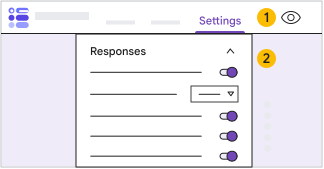

Comparing forms created on Google Forms (on the left) and Microsoft Forms (on the right)
Best Building Experience: Google Forms
Google Forms has documented templates, multiple question types, and basic logic branching, plus collaboration via sharing forms with other users. Microsoft Forms supports surveys, polls, and quizzes, but the provided sources do not verify comparable detail on builder controls (question formats, logic depth, or templates).
Best Pricing: Microsoft Forms
Microsoft Forms is described in the provided source as a free tool (with “Free: Free” listed). Google Forms can be used with a personal Google account and is included with Google Workspace, but the provided sources did not include concrete Forms-specific plan limits or pricing tiers, making value harder to assess from the record.
Both tools offer a discount for annual billing. Check their pricing pages for the latest offers.
Best Functionality: Google Forms
Google Forms has clearly stated survey basics plus branching logic and a confirmed export path to Google Sheets for deeper analysis. Microsoft Forms is described at a high level (surveys/polls/quizzes and an “AI powered” claim), but the specific AI capabilities, analytics/export depth, integrations, and limits were not available in the provided pages.
Best Support: Google Forms
Neither record includes concrete support or documentation findings from hands-on evaluation. Google Forms has more specific, verifiable workflow details in the provided sources (sharing options, summaries, Sheets export), which typically reduces reliance on support for basic use; Microsoft Forms support channels were not described in the provided bundle.
The Final Verdict: Should you use Google Forms or Microsoft Forms?
Google Forms and Microsoft Forms are closely matched for basic survey tasks, and both sets of ratings are neutral due to limited verifiable detail in the provided sources. If your priority is a simple survey tool with a clear path to deeper analysis, Google Forms has the advantage because Google Sheets export is explicitly supported and the sharing options (link, email, embed) are clearly documented. If your priority is starting free and keeping everything in the Microsoft ecosystem, Microsoft Forms is the safer pick based on the record’s “Free tool” positioning. For anything that depends on advanced branching, research-grade question formats, or strong built-in reporting, neither tool is a clear winner here and you should compare dedicated survey platforms. In practice, pick the one that matches your organization’s suite (Google Workspace vs Microsoft 365) unless you already know you need more advanced survey capabilities.
This comparison is based on our standardized testing methodology where we put both tools through the same rigorous evaluation process.
- We create real accounts and build actual forms.
- We test specific features like logic, payments, and integrations.
- We evaluate the respondent experience on mobile and desktop.
- We verify pricing claims and support responsiveness.